
Seaming processes are used to seal thin-walled packaging. The resulting seam quality is influenced by numerous factors, including component geometry, material behavior, and tool and process settings. These complex interactions make it difficult to predict the seaming outcome and result in significant effort during machine development, testing, and setup. Suitable process settings are currently determined based on expert knowledge and extensive experimental trials.
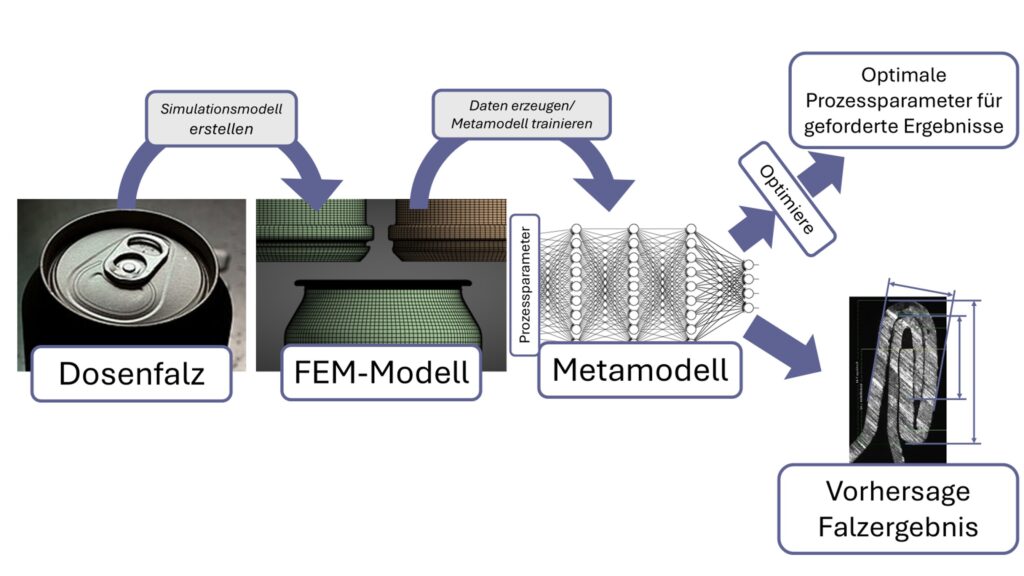
In a joint research project between Krones AG and the KTmfk, a simulation- and data-driven approach for the modeling and optimization of the seaming process is being developed. The foundation of this approach is a simplified finite element model that captures the relevant relationships between process settings, component properties, and resulting quality characteristics, while also providing data for further model development.
Based on the generated simulation and experimental data, metamodels are being developed. These models are intended to predict the results of the seaming process within a short time and determine suitable process parameters for specified quality targets. Real process data are used to validate the developed models and the process settings derived from them. This work will result in an approach that supports the development and design of seaming processes as well as the setup of corresponding machinery. At the same time, setup times are expected to be significantly reduced, while dependence on expert knowledge and extensive experimental testing is minimized.