
Energy-efficient technical systems thanks to lightweight design
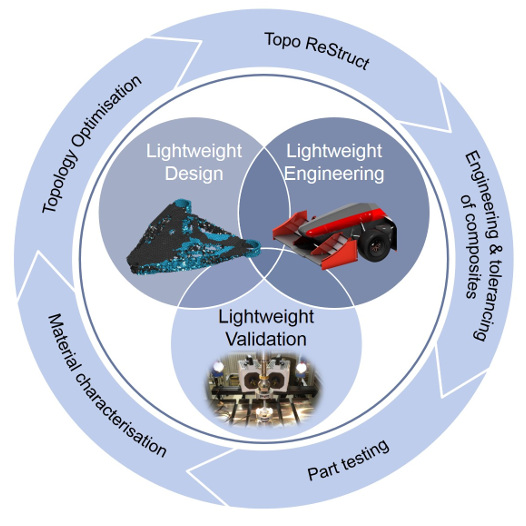
In recent years, the energy efficiency of technical systems has gained importance across many different industrial sectors. As a result of this shift in thinking, lightweight design plays a pivotal role in product development, as reducing unnecessary mass enables the creation of products that are significantly more resource-efficient. The activities of the KTmfk in the field of lightweight construction can be categorized into three distinct areas: lightweight design, lightweight engineering, and lightweight validation. Through various studies and research projects, innovative solutions have already been developed that contribute to a more extensive utilization of the lightweight potential inherent in technical systems.
Lightweight-Design
Integration of structural optimization methods into the design process
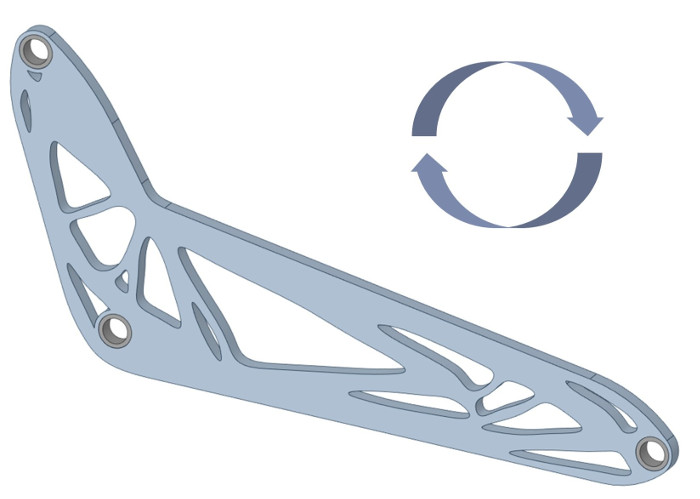
Discrete and continuous structural optimization methods are becoming established as efficient tools for shape generation in lightweight design within the product development process. However, the benefits of structural optimization are often diminished by the time-consuming reconstruction and interpretation of the optimization results. Consequently, methods and tools are being developed at KTmfk to enable the conversion of structural optimization results into feature-based CAD models.
Lightweight-Engineering
Design of fiber-reinforced plastic components in the early phases
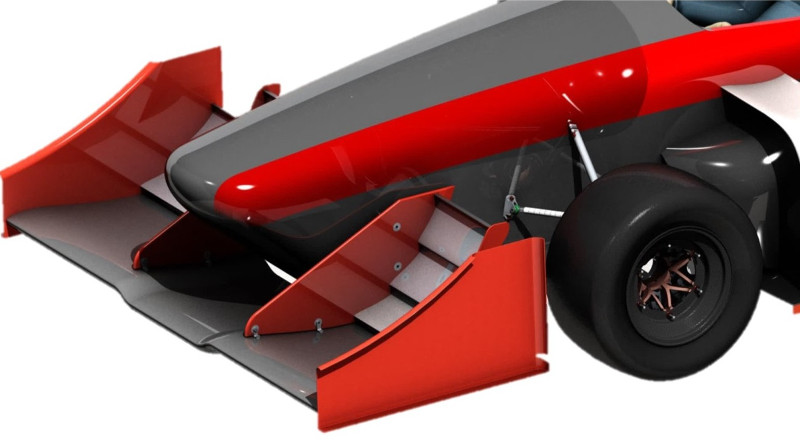
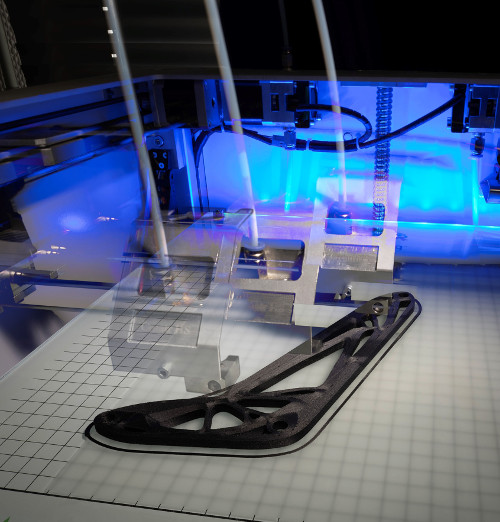
Fiber-reinforced plastic components are increasingly being used in modern lightweight structures due to their excellent mechanical properties. However, designing these components presents significant challenges for product developers, as the mechanical properties of these composite materials depend heavily on fiber orientation tailored to the specific loading conditions. Consequently, a key focus is the development of strategies and methods for designing fiber-reinforced plastic components and structures during the early stages of product development. Particular emphasis is placed on short-fiber-reinforced thermoplastics and continuous-fiber-reinforced CFRP components.
Lightweight-Validation
Characterization of materials under highly dynamic and cyclic loading
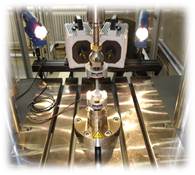
Accurately determining material behavior under highly dynamic loading is essential for simulating the crash behavior of components. To this end, KTmfk is equipped with a high-performance setup comprising a servo-hydraulic high-speed tensile testing system and an optical analysis system featuring two high-speed cameras. A servo-hydraulic pulsator complements this equipment, enabling the investigation of material behavior under cyclic loading.