
Our Vision
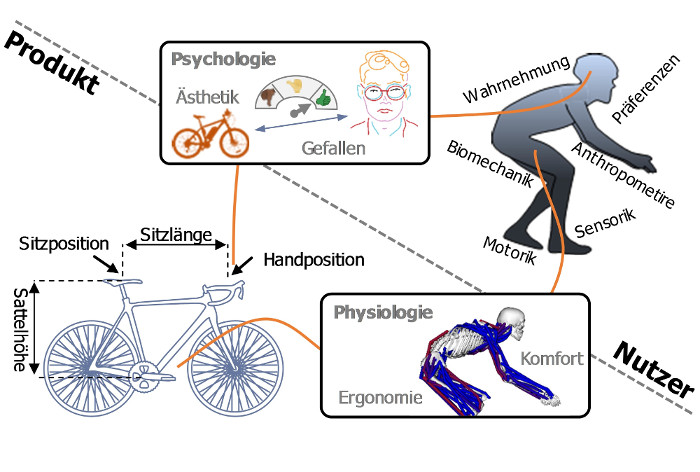
In user-centered product development, the human being—with their individual capabilities, needs, and expectations—lies at the heart of the development process. The interaction between product and user is a key aspect of this. At KTmfk, our goal is to develop innovative methods and tools that enable the virtual design and optimization of interaction interfaces for user-centered products. By combining biomechanical simulations with the analysis of product perception and preference studies, we aim to contribute to the development of comprehensive, statistically grounded behavioral predictions. Our approach makes it possible to better understand user behavior and, in the long term, develop more precise methods for user-centered product design.
User-Product Interaction
The foundation for user-centered optimization is a detailed representation of the interaction between user and product. This requires a precise description of both relevant product properties and individual user characteristics. The product is viewed as part of a feedback system in which user behavior and product properties mutually influence one another.
In addition to purely physical interaction, sensory and motor processes must also be taken into account. Product perception, as well as individual preferences and cognitive factors, play a crucial role in user behavior. In this context, we investigate how the concept of affordances—that is, the action possibilities offered by a product—can be utilized to improve the modeling of user-product interaction.
Research Focus Areas
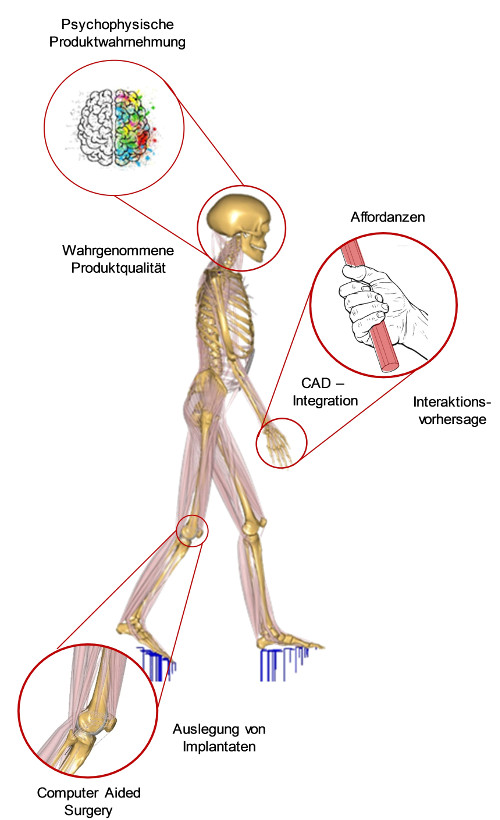
Our research focuses on developing suitable methods for the virtual representation of users and their interactions with products. Particular emphasis is placed on combining motion synthesis, biomechanical simulations, and psychophysical studies regarding product perception. A key aspect of this work is improving data continuity between digital human models and modern CAD systems. Seamless integration of these systems enables the development of realistic simulations that allow for more precise modeling of user behavior.
Furthermore, we investigate the customization of biomechanical human models for specific application areas, such as computer-aided surgery. We focus particularly on the preoperative planning of joint replacement procedures and the incorporation of sensorimotor functions into musculoskeletal simulations. Through our research, we make a significant contribution to developing methods that enable a more comprehensive, data-driven analysis of user behavior. Linking biomechanical simulations with studies on preferences and perception offers potential for the future development of holistic, statistical behavioral predictions.
Potential fields of application
Our research finds application in areas characterized by significant user interaction. These include, in particular, sports equipment and consumer goods, exoskeletons, orthopedics and rehabilitation technology, and the automotive industry. By combining biomechanical simulation, product perception studies, and methods for analyzing user behavior, we help establish an improved foundation for the individual and adaptive design of products.