
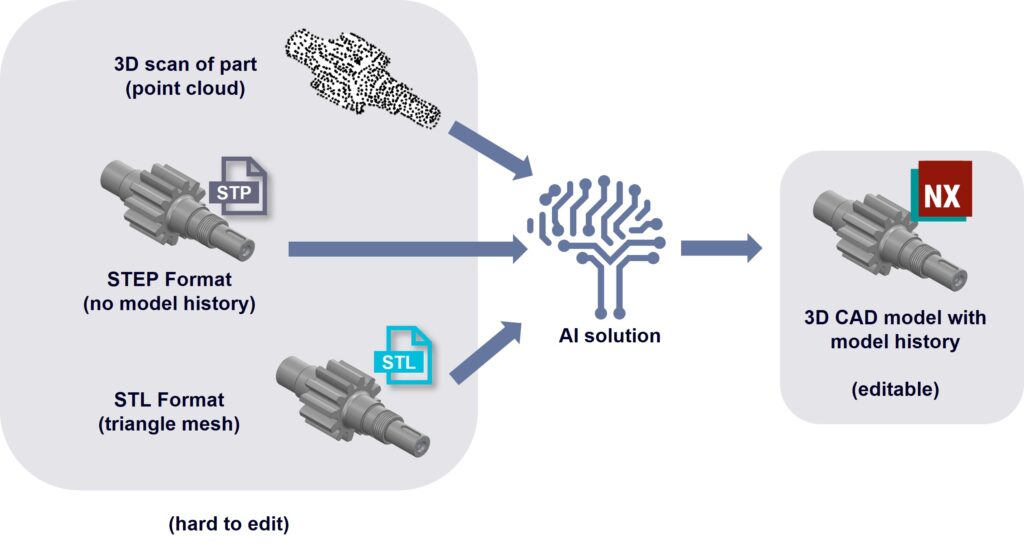
Parametric 3D CAD models are an important foundation of product development. Their modeling history (or feature tree) describes the step-by-step construction of the 3D geometry and enables targeted modifications through parameters such as lengths, diameters, or angles. However, when exchanging data in STEP format (ISO 10303-242) or exporting models as STL files, this history is often no longer available. Likewise, 3D scans capture only the external shape of a component in the form of point clouds. To enable parametric editing, design engineers therefore often have to manually reconstruct the geometry in a 3D CAD system.
In collaboration with Siemens AI Research, we are investigating how generative artificial intelligence can reconstruct editable 3D CAD models from such geometric data. To this end, the modeling history is represented as a text-based program that defines the modeling operations and their parameters. A multimodal language model is trained to generate such programs from the input geometry. Additional images and textual instructions are intended to guide the reconstruction process. Point clouds serve as a unified geometric input representation: they can be obtained either from 3D scans or by sampling the surfaces of STEP and STL models.
The focus is not solely on geometric similarity. The goal is to generate valid, interpretable, and meaningfully parameterized modeling histories that are suitable for subsequent design modifications. Since the same geometry can be created through different sequences of modeling operations, the approach should be capable of generating multiple plausible modeling histories. In this way, the project aims to reduce the effort required for manual reconstruction and facilitate the reuse of existing geometric data. The research project has been running since September 2024 and is scheduled for completion in September 2027.