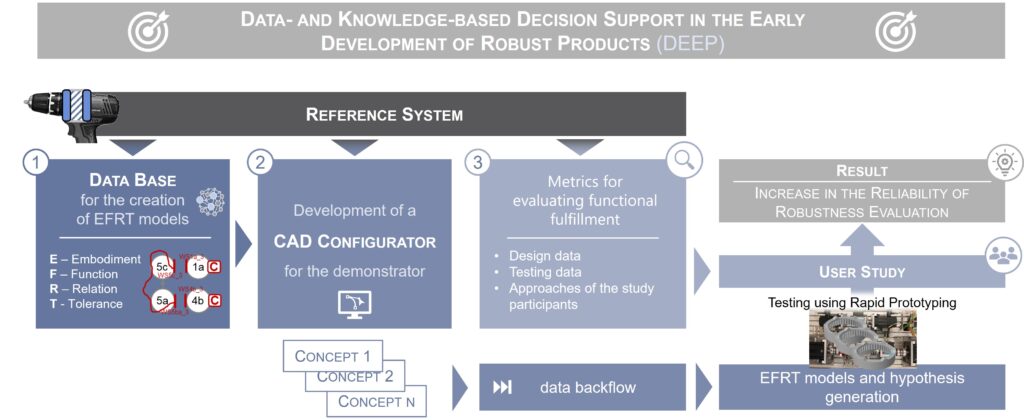
How can informed design decisions be made in early development to ensure reliable product performance despite geometric variations? The DFG-funded project “DEEP” addresses this question. It aims to develop an approach to data- and knowledge-based decision support for the early development of robust products.
Existing robustness assessments often lack reliability. Insufficient modelling depth and subjective judgements hinder informed decisions, potentially leading to inadequate product robustness and higher costs. DEEP therefore combines existing product data with the systematic generation and validation of knowledge.
The approach builds on the EFRT model developed in the preceding project, which represents the relationships between a product’s geometry, function and tolerances. First, reference system data, such as CAD models and data from later development stages, are structured and semantically linked using ontologies. These provide the data foundation for systematically transforming product data into EFRT models for early development, supporting model creation and reducing the effort required to build meaningful models.
Building on this foundation, methods are developed to formulate and test design hypotheses systematically. Physical surrogate models and rapid prototyping enable early investigations of functional behaviour. The resulting insights are intended to help designers, including those without extensive expert knowledge, assess how their decisions affect product robustness.
The DEEP approach will then be applied, evaluated and refined through participant studies. Following training, participants will carry out design tasks using the reference system. Measurable criteria will be used to assess how reliably the resulting solutions fulfil their function despite geometric variations.
In close collaboration with IPEK at the Karlsruhe Institute of Technology, DEEP aims to provide a more reliable basis for early design decisions and extend the scope of application of the EFRT model.
Start of the DFG-funded project “DEEP” for the development of robust products