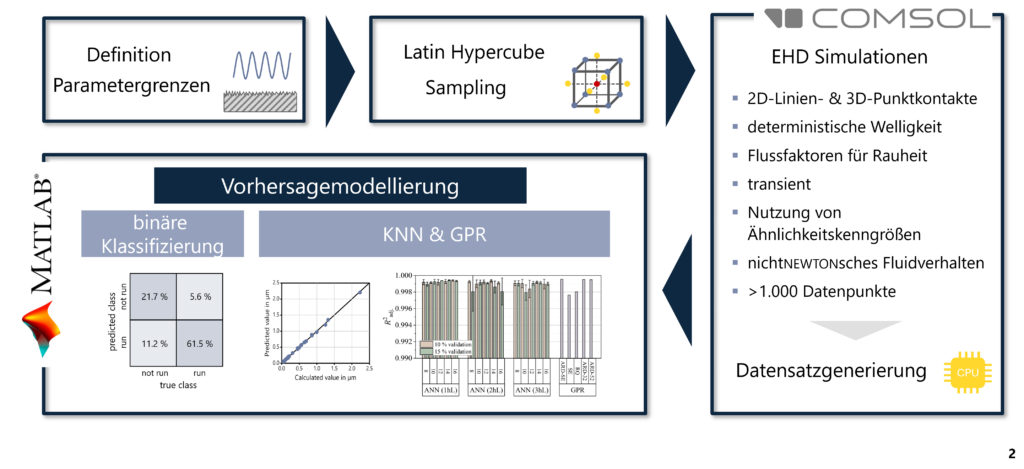
For the development of wear-resistant and energy-efficient machine elements with lubricated dynamic contacts, the realistic determination of relevant lubrication parameters is crucial. Elastohydrodynamic lubricated (EHL) simulations enable the detailed consideration of manufacturing-related surface deviations and thus the realistic calculation of lubricant film thicknesses and pressures. However, such EHL simulations involve a high computational effort and long computation times. Against this background, the DFG-funded research project DeviaTEHD (WA 2913/48-1; 461627688) focused on the development of time-efficient prediction models for EHL contacts with surface deviations.
For this purpose, databases comprising more than 1,000 EHD simulations each were generated based on Latin hypercube sampling for roughness- and waviness-affected 2D line contacts as well as roughness-affected 3D point contacts. These databases served as training, validation, and test data for the development of data-driven prediction models using machine learning. To achieve high prediction accuracies, models based on artificial neural networks and Gaussian process regression were developed and compared as part of a comprehensive hyperparameter optimization. For the prediction of minimum and central lubricant film thicknesses, maximum total pressures, and maximum solid contact pressures, coefficients of determination of R² ≥ 0.99 were achieved in most cases. In addition, binary classification models were developed to assess the applicability of the prediction models for different contact conditions.
In summary, the developed prediction models enable the time-efficient determination of relevant lubrication parameters in EHL contacts while accounting for surface deviations, thereby providing a basis for the design and optimization of lubricated machine elements.
Completion of the DFG-project DeviaTEHD