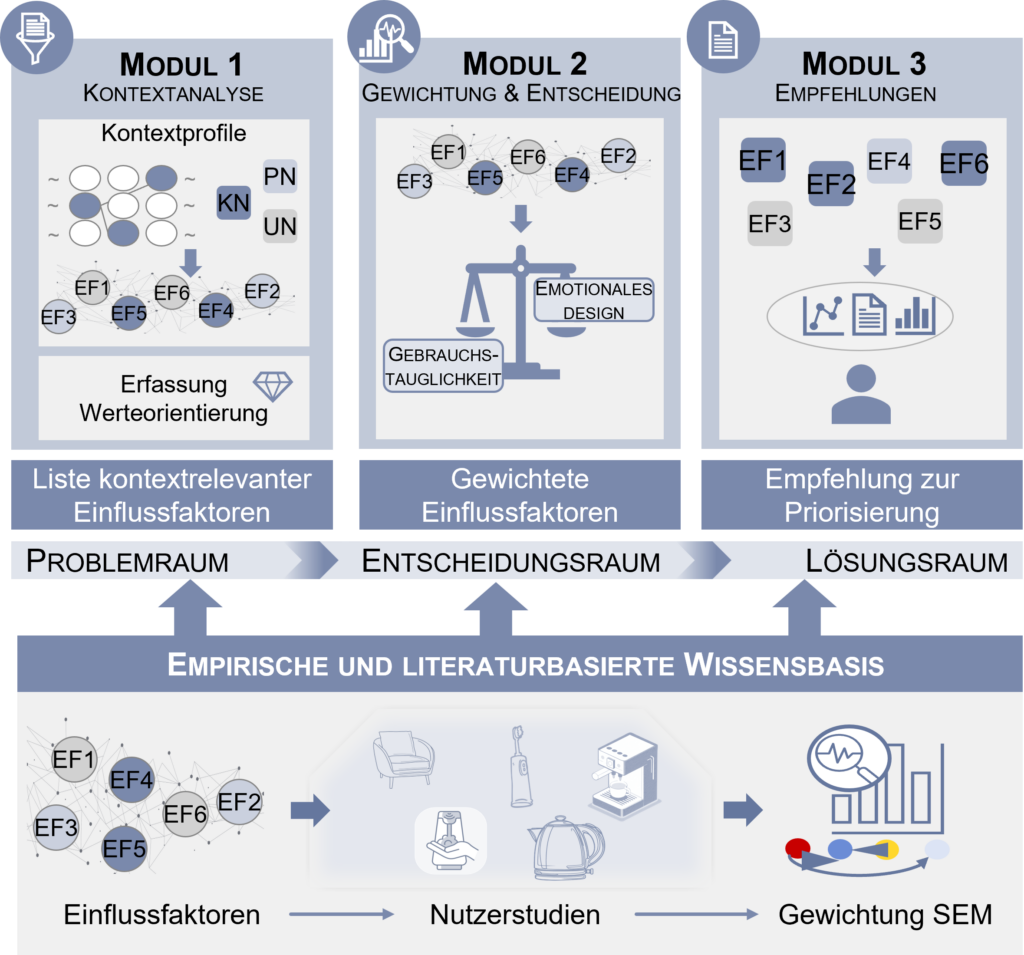
Usability and emotional product design are regarded as equally important components of the user experience. In development practice, however, these two aspects often conflict with one another, requiring a prioritisation. The weighting given to each component depends on the specific context of use – that is, on the characteristics of the users, the product and the usage environment. Whilst established models of the user experience do identify such influences, they do not operationalise them for technical product development.
The DFG project ‘NEPTUN GeP – User, Product and Environmental Influences on Usability and Emotional Product Design’ therefore investigated a context-sensitive decision-support method. It is based on an empirical knowledge base derived from a systematic literature review and seven empirical user studies, which examined, amongst other things, the effects of gender, age, self-efficacy, product type, degree of aesthetic appeal, prior experience and value orientation. The resulting method is structured into three modules: the structured analysis of the usage context, a knowledge-based weighting logic based on the Analytic Hierarchy Process, and the derivation of design implications and initial user-centred requirements.
The concept was implemented as a prototypical digital assistance system that combines context detection, weighting and the generation of recommendations in a seamless workflow. The evaluation was carried out using an application example from medical technology – a health smartwatch for people aged 65 and over – as well as in a study involving product development practitioners, who particularly highlighted the transparency of the weighting processes and the support provided for structuring the context analysis. This provides a tool that offers data-driven and transparent support for conflict-ridden design decisions in early development phases. Opportunities for further work lie in expanding the knowledge base to include domain-specific studies and in applying the principle to other conflicting objectives in product development.
Completion of the DFG project “NEPTUN GeP” on user-centred product design