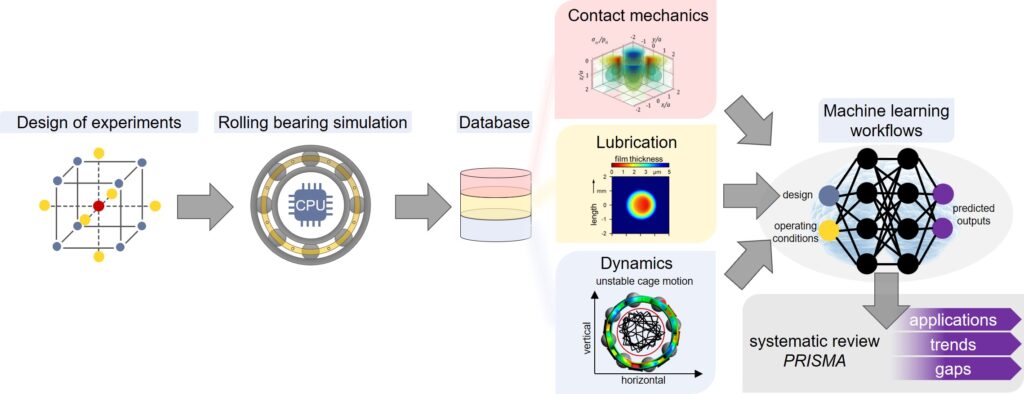
The simulation-based design of rolling bearings makes it possible to assess the effects of design changes on performance in the areas of contact mechanics, lubrication, and dynamics at an early stage. Machine learning can further enhance this assessment by leveraging learned relationships.
A recent publication provides a systematic overview of how machine learning is used in rolling bearing simulations when simulation data form the primary basis for supervised learning. In doing so, existing applications are compared and research gaps are identified. The article outlines methodological building blocks and guidelines for developing suitable ML workflows for the simulation-based analysis and optimization of rolling bearings.
https://doi.org/10.3390/lubricants14040163
Machine Learning for Efficient Rolling Bearing Simulations